
Short answer
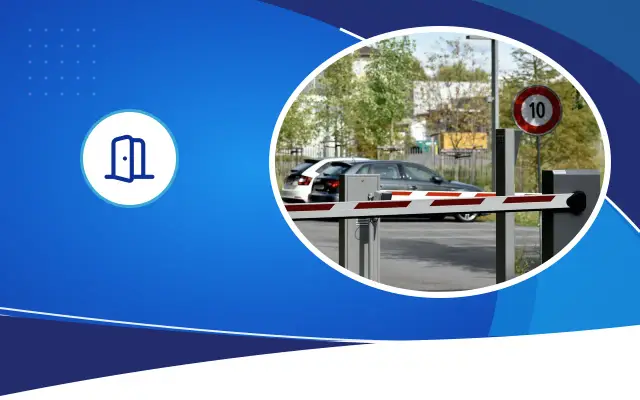
A parking management system combines the entry and exit barriers with license plate recognition cameras and software. Subscriber vehicles pass automatically by plate, the entry time of guest vehicles is recorded, and the duration is calculated at exit. Plate reading success depends on the camera angle, the light and the condition of the plate; the installation should be done with these three factors in mind.
What does parking management solve?
Keeping a staff member at a car park entrance, issuing tickets and calculating fees by hand at exit means both labor and mistakes. Lost tickets, wrongly calculated durations, vehicles whose subscription has ended but still get in, and queues in the morning hours are the most common problems.
In an automatic system, the vehicle stops or slows down at the entry, the camera reads the plate and the barrier opens. The software records the vehicle's entry time. For subscriber vehicles no duration is calculated; the system only checks whether the subscription is valid. For a guest vehicle, the duration is calculated on the way out and payment is taken or confirmed. The manager can also see the occupancy rate, the busiest hours and the revenue report in the software.
Free car parks also benefit from this system. A hospital's staff car park or a factory's employee car park charges no fee but wants only authorized vehicles to enter. In this case the software opens the barrier according to the plate list only, without a payment module, and keeps an entry and exit log. The same setup is used for housing estate car parks; residents' vehicles are registered, and guests enter with the approval of staff.
How does license plate recognition work?
License plate recognition (ANPR or LPR) is software that finds the plate in the image the camera captures and reads the characters. In some models the camera does the reading itself; in others the image is sent to a computer or a recorder and processed there.
The factors that determine reading success are well known. The camera should see the plate from a narrow angle, from the front and at a sufficient size. A camera that sees the plate from too far to the side or from above makes mistakes. Infrared lighting is needed for night reading; headlight glare and the sun hitting the lens directly must also be taken into account. Dirty, muddy, bent or non-standard plates are difficult for every system.
Expert note: Position the camera according to the point where the vehicle stops or slows down. The plate of a fast-moving vehicle is harder to read than that of a stopped one. Placing a ground loop a few meters in front of the barrier and slowing the vehicle there improves reading success.
Subscriber, guest and special vehicles
The user types of a car park are defined separately in the software. A different rule applies to each type.
- Subscriber vehicles: the plate is registered in the system and valid until a set date. At the end of the term it automatically falls under the guest rule.
- Guest vehicles: the entry time is recorded and the fee is calculated at exit according to the duration.
- Exempt vehicles: those that pass free of charge, such as ambulances, fire trucks, municipal vehicles and staff vehicles.
- Blacklist: vehicles with an unpaid debt or earlier problems; entry is blocked or staff are alerted.
- Vehicles whose plate cannot be read: backup entry with staff assistance or a ticket machine.
- Camera angle and distance
- Sun and headlight glare
- Night infrared lighting
- Dirty or damaged plate
- Vehicle speed
- Camera glass cleanliness
Payment and exit arrangement
In paid car parks, payment can be taken in three different places: from a staff member in the booth at the exit, at a payment machine inside the car park, or at an automatic cashier next to the exit barrier. If a payment machine is used, the driver pays first and then goes to the exit; at the exit the camera reads the plate and, if payment has been made, the barrier opens.
Mobile payment and plate-linked payment apps are also used. Whichever method is chosen, there should be an intercom button at the exit that the driver can use to call staff, so the driver is not stuck in the car park when payment fails or a device breaks down. At night this button can be routed to a staff member at a central point or to a phone. Which payment method to choose depends on the size of the car park, the number of staff and the user profile. The compliance of payment devices and software with legal invoice or receipt requirements should be assessed separately; consult your accountant on this.
The difference between indoor and outdoor car parks
In indoor car parks, ceiling height affects the choice of barrier; if the arm would touch the ceiling as it rises, an articulated arm is used. Because the light is constant, plate reading is usually easier. If there are many floors, sensors showing the occupancy of each floor and a direction sign at the entrance can be added.
In outdoor car parks, sun and weather conditions are decisive. The summer sun in Şanlıurfa can hit the camera directly around midday; the camera direction should be chosen accordingly and a sun shield used. Dust builds up on the camera glass and reflects the night infrared light. Regular cleaning of the camera glass should be written into the maintenance plan.
In busy places such as hospital, shopping mall and municipal car parks, the number of entry and exit lanes is set according to the number of vehicles at the busiest hour. A car park entrance squeezed into a single lane creates a queue on the main street. A flexible lane definition can be set up in the software so that one lane can be switched to the entry or exit direction at busy hours.
Records and KVKK
A plate counts as personal data because it can be linked to a person. The plate, entry and exit time and camera image collected by a parking system are assessed under Law No. 6698. A notice sign stating that license plate recognition and camera recording are in use should be placed at the entrance, the retention period of the records should be set and access rights should be limited. For obligations specific to your own business, get an opinion from a legal advisor.
Protecting the records technically is just as important. Who accesses the parking software and with what authority should be tracked with separate user accounts, and a shared password should not be used. If the software is exposed to the internet it should be kept up to date, and remote access should go through a secure connection. A plate lookup should be done only when the work requires it and in a way that is logged.
What to ask when choosing a system
The cost of a parking system varies with the number of lanes, the barrier type, the cameras and reading software, the payment hardware and the software's license model. When asking for a quote, ask these: is the plate reading software set up for the Turkish plate format, does the system keep working when the internet goes down, can the reports be exported, and whose service covers the payment devices?
Desa Bilişim installs barriers, license plate recognition and entry and exit management for car parks in Şanlıurfa. We can see your car park's number of lanes and user structure on site and recommend a suitable system.
Frequently asked
Does a license plate recognition system read every plate?
A correctly installed system reads most standard, clean plates. Errors can occur with dirty, bent or non-standard plates. That is why a backup entry method, such as staff assistance or a ticket, should be planned.
Can license plate recognition be added to my existing barrier?
Most barriers have an external open input on the control board, and license plate recognition can be connected to this input. If the barrier's speed and condition are not enough for heavy traffic, the barrier may need to be replaced as well.
How long should parking records be kept?
The retention period is set according to the purpose of the business and the KVKK principle of keeping data only as long as necessary. There is no single correct period. For the period that suits your business, get an opinion from a legal advisor.
Let's plan the entry and exit for your car park
Share your number of lanes and your user structure, and we will inspect on site and prepare a written quote.