
Short answer
Low-voltage (ELV) systems is the general name for systems that run on low voltage and carry signals and data instead of power. Security cameras, fire detection, data and phone network, video intercomdoor phone, central TV, PA and announcement, card access, and burglar alarm are the main ELV systems in a building. The wiring that feeds lighting, outlets, and motors stays on the power-wiring side.
The difference between power wiring and ELV systems
Power wiring distributes energy in the building: outlets, lighting, air conditioning, the elevator motor. ELV wiring carries information: the camera's image, a detector's alarm signal, internet data, the sound of the door phone.
The distinction matters in day-to-day work, because the two kinds of wiring need different cables, different conduits, and different expertise. Running a camera cable in the same conduit as a power cable over a long distance can cause noise in the image. The assumption that an electrician can do every job is also a common mistake; terminating and testing data cable takes a separate skill.
This distinction also helps when looking for a fault. When the camera image drops out, the problem can be in the camera, the cable, the switch port, or the power supply. In a building where cables are labeled and systems are on separate routes, finding the right cause takes minutes; in mixed wiring it can take hours.
ELV systems in a building
Not every building has all of them. In an apartment building, a door phone, satellite, and a few cameras may be enough; in a hospital, almost all the systems on the list are present.
- Security cameras (CCTV): video recording and monitoring
- Fire detection and alarm: detector, manual call point, sounder, panel
- Burglar alarm: door and motion sensors, alarm panel
- Data and phone network: structured cabling, switch, wireless access point
- Video door phone: door panel and apartment monitor
- Central satellite and TV distribution
- PA and announcement: school bell, voice evacuation, mosque and hall sound system
- Card access, turnstile and time & attendance control
- Barrier and automatic gate control
Expert note: Choose the cable type according to the system. Category cable is used for data, fire-resistant cable for fire, and coaxial cable for TV; running one in place of another creates replacement work later.
How are the systems connected to each other?
In the past, each system had its own cable and sat in its own box. Today, a large part of cameras, door phones, access control, and even announcement systems are IP-based and use the same network infrastructure. This means a well-planned network can carry many systems.
Some of the connections are made for safety. When the fire panel gives an alarm, access doors opening, the barrier in the parking lot rising, or the announcement system giving an evacuation message is this kind of integration. How these connections will work is determined during design, taking the relevant regulations and standards into account.
Using a shared network also has a cost. If camera traffic and office computer traffic get mixed on the same network, speed drops and security risk rises. That is why, even when systems share the same cable, they are separated from each other on the network with methods such as VLAN. A VLAN is a switch feature that divides a single physical network into logically separate sections.
- Security camera
- Fire detection
- Data and phone network
- Central TV
- Sound and PA
- Card access
Shared infrastructure: cabinet, server room, and power
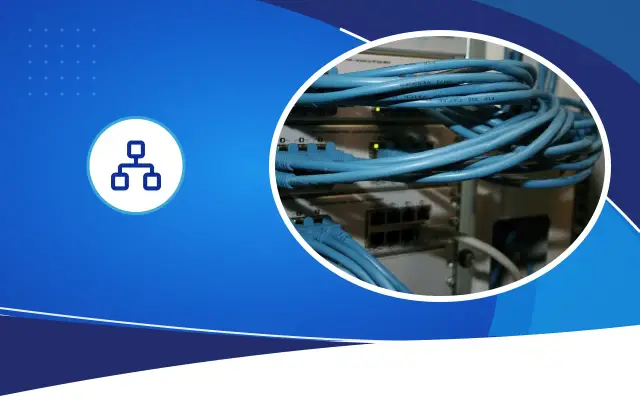
The heart of ELV systems is the distribution cabinets and the server room. The recorder, switch, TV headend, and fire panel are gathered here. The layout of the cabinet, the labeling of the cables, and ventilation determine how quickly you can respond when something fails.
An uninterruptible power supply and batteries are planned so that cameras and the alarm keep working when the power goes out. Voltage fluctuations, which are common in Şanlıurfa during the summer months, also bring surge protection into the picture.
Another part of the shared infrastructure is grounding. If the cabinet to which the camera, switch, and recorder are connected is not properly grounded, device failures and noise in the image can appear during voltage fluctuations. Grounding measurement is the electrical team's job; the ELV team should ask before handover whether this measurement has been done.
Common mistakes in low-voltage work
The most common mistake we see is leaving low-voltage work to the end of construction. Cable trays get stuck onto walls where no conduit was left, there is no room for a cabinet, and the server room gets squeezed into a space used as storage.
The second mistake is giving each system to a different company piece by piece, with nobody seeing the whole. The camera company puts the switch in one corner, the data company sets up the cabinet somewhere else, and you end up with two separate, scattered infrastructures. Seeing all the systems on a single project drawing prevents this problem.
Which systems stand out by building type?
In a detached house, low-voltage work is often just a door phone, a few cameras, a burglar alarm, and the home network. If a smart home system will be added, the control lines running to outlets, curtains, and lighting also go on this list.
In a school, the bell and announcements, cameras, fire detection, and a wireless network reaching the classrooms stand out. A factory needs wide-area cameras, fire detection, time & attendance control, and a network spread across the site. In hotels, central TV or IPTV and guest internet infrastructure move to the top of the list.
In farmland where the power and internet lines are far away, like the Harran Plain, camera and alarm systems are powered by solar energy and the image is sent over a mobile line. Here, the low-voltage system and the power system need to be designed together.
Which systems are mandatory?
What is mandatory varies with the system and the building. Fire detection may be mandatory under the Regulation on the Fire Protection of Buildings, depending on the purpose of use and size of the building. Systems such as cameras or card access are optional in most buildings, but separate regulations may apply in some sectors.
For a new building, the project designer determines which systems are mandatory according to the regulation. Desa Bilişim plans and installs all low-voltage systems from a single source; on the question of what is mandatory, the opinion of the authority that will approve the project should be the basis.
Expert note: On regulations and requirements, consult your organization's legal department, your project designer, or a specialist.
Frequently asked
Are ELV systems and low voltage the same thing?
In everyday use, ELV is a term for low-voltage systems that carry signals and data. Voltage classifications in technical regulations rely on separate definitions; in project language, it is good to clarify the scope of the two terms with the project designer.
Can an electrician do ELV work?
The electrical team can do the conduit and cable pulling, but terminating and testing data cable and programming the cameras and fire panel call for separate expertise. It is better to leave this part of the job to a team that installs these systems regularly.
Can an ELV system be added to an existing building?
Yes. If there is no conduit, cable trays, spaces above suspended ceilings, or wireless solutions are used. It takes more labor than in a new building, and how it looks depends on the structure of the building.
Let's see the systems in your building on a single plan
Contact us to work out together which low-voltage system you need.