
Short answer
A manual call point is placed where a person who sees a fire can easily press it while escaping: floor exits, the heads of staircases and next to building exit doors. The sounder is distributed so that it can be heard at every point in the building, even with the doors closed. The strobe complements the audible warning visually in noisy areas and in places where people with hearing impairments may be present.
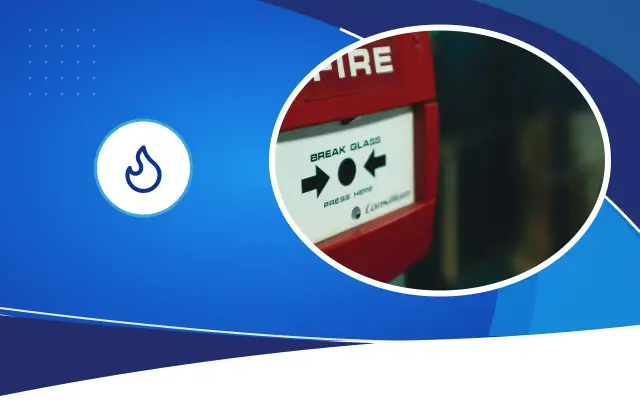
What is a manual call point for?
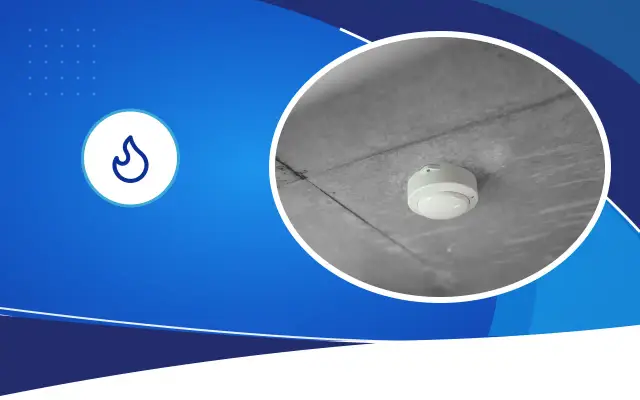
Detectors sense a fire on their own, but they may not notice every fire at the earliest moment. When an employee sees an outlet sparking in a corridor or sees flames in a warehouse, they should be able to start the alarm without waiting for a detector to react. The manual call point makes this possible.
Most call points are of the “break glass” or “push” type. In most new models there is a flexible panel instead of real glass; when pressed it stays in place and is restored with a test key. The panel sees that the call point has been pressed and starts the alarm. In addressable systems, the panel also shows which call point was pressed.
Pressing the call point starts the alarm; it does not call the fire department by itself. If the panel is not connected to a monitoring center, the fire department must be called separately on 112. Telling building occupants and employees this clearly prevents situations where everyone assumes someone else has called.
Where are manual call points placed?
The basic logic of call point placement is this: a person who sees a fire should find a call point on their way out of the building and should not have to go back. That is why call points are placed along escape routes.
- Next to the door of each floor that opens onto the stairwell
- Next to the building’s exit doors leading outside
- In long corridors, at intervals that are not too far apart
- At the exit of risky areas such as kitchens, boiler rooms and warehouses
- On a visible wall that will not be blocked and that everyone can reach
Expert note: Do not allow cabinets, plant pots or stacked goods in front of a manual call point. Call points placed in the right spot at installation can end up behind furniture within a few years. Add this item to the building attendant’s regular checklist.
Distance between call points and mounting height
Measurements such as the maximum distance between call points, the height at which they are mounted and how many call points are needed per floor are defined in the regulation, the relevant standards and design guides. These measurements must be applied in the project according to the building’s plan. Instead of applying a number you came across online directly, rely on the layout in the fire project.
In practice, the point to watch is that the call point can be seen and reached comfortably by everyone, including a person using a wheelchair or a child. A call point mounted too high or behind a door exists on paper but is not used.
In schools, gyms and crowded areas, call points with covers or protection may be preferred. The cover makes it harder to press by accident or as a prank, but opens easily in an emergency.
- Escape routes and exits
- Ambient noise
- Visibility and accessibility
- User profile
- Floor and partition layout
- Exterior conditions
Where and how many sounders?
The sounder’s only job is to announce the alarm to everyone. That is why the number and location of sounders are planned so that they can be heard even in the farthest and most enclosed corner of the building. A single sounder in the corridor is often not enough; a person in a meeting room with the door closed, in a workshop with machines running or asleep in a hotel room may not hear the sounder in the corridor.
Whether the sounder volume is sufficient is assessed according to ambient noise. In noisy production areas, a more powerful sounder or more devices are needed. In buildings with dormitories, it is important that the sound is at a level that will wake a sleeping person. The values required for sound level are defined in the standards and applied in the project.
When increasing the number of sounders, watch out for the other extreme too. A very loud sounder in a small room makes people panic and, if there is a PA system, makes the announcement hard to understand.
After installation, the simplest test is this: while the sounder is sounding, go to the farthest room in the building, close the door and listen. If you can barely hear it, that section needs an additional warning device. Do this test especially in dormitories and hotel rooms that are used at night.
When is a strobe needed?
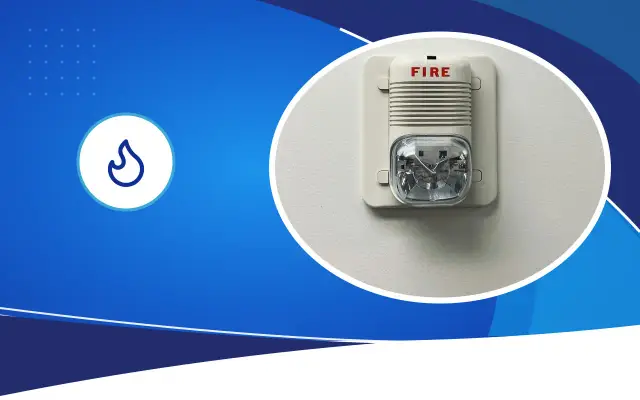
A strobe is the visual complement of the audible warning. Areas where people with hearing impairments may be present, places where people work wearing headphones and workshops with high noise levels are where a strobe helps most. In hospitals, hotels, schools, public buildings and factories, a strobe is often considered together with a sounder.
There are also devices that combine a sounder and a strobe in a single housing. They are practical in terms of cabling and installation. The strobe’s light should be positioned so that it can be seen from everywhere in its area; a strobe behind a column is useless.
Exterior sounders and strobes show people outside the building and the fire department which building the alarm is in. In Şanlıurfa, exterior devices must be resistant to sun, dust and rain, with a suitable protection class. Cleaning the lens after a dust storm is also part of maintenance.
Relationship with the panel, PA and other systems
Sounders and strobes are connected to the panel’s notification outputs. The panel knows which warning devices to run in which situation. In large buildings, staged scenarios can be set up, such as giving the alarm first on the floor with the fire and then throughout the building; whether this is suitable is decided in the project.
If the building has an emergency PA system, the sounder and the announcement must not drown each other out. In some buildings a voice evacuation message is used instead of or together with the sounder. A recorded message tells people what to do.
The cables of warning devices are run with the fire-resistant cable specified in the project so that they can keep working for some time during a fire. A cheap and unsuitable cable can cause the sounder to go silent just when it is needed.
Common mistakes in placement
The mistakes we see most often on site are these: call points placed only at the main entrance and the rear exits left empty; sounders fitted only in corridors and closed halls forgotten; new partition walls built in a renovation but the locations of sounders and strobes not updated; the exterior sounder fading and cracking in the sun.
Another mistake is not testing the warning devices. A sounder that worked at installation can stay silent if its cable was damaged in a renovation. In maintenance, every sounder and strobe must be checked one by one.
At Desa Bilişim, we assess the placement of call points, sounders and strobes together with the building’s escape plan. In your existing building, we can work together to identify devices that are missing or in the wrong place.
Frequently asked
At what height is a manual call point mounted?
The mounting height is set in the regulation, the standards and the project. What matters is that the call point can be seen and reached comfortably by everyone. For the exact measurement, look at your building’s fire project.
Does every room need a sounder?
Not every room may need its own sounder, but the alarm must be audible in every room. In closed-door halls, dormitories and noisy workshops, a sounder in the corridor may not be enough. The number and location are determined in the project.
Is a strobe mandatory?
Whether it is needed depends on the building’s use and the conditions in the regulation. In places where people with hearing impairments may be present and in noisy areas, the strobe covers the cases where the audible warning is not heard. Consult the designer for the exact obligation.
Let’s review your warning devices
Let’s walk through your building together and check whether the call points, sounders and strobes are in the right places according to the escape plan.