Short answer
When sound in a mosque is hard to understand, the cause is usually echo, not a lack of power. The dome and stone walls reflect sound for a long time; the solution is to use speakers that are close to the congregation and aimed in the right direction instead of a few powerful ones, and to adjust indoor and outdoor sound separately.
Why does sound echo in a mosque?
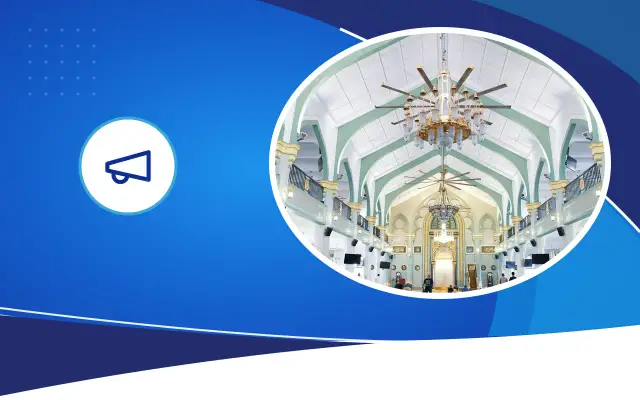
A mosque interior has a high ceiling, a dome and hard surfaces. Stone, marble, plaster and glass do not absorb sound; they reflect it back. While a syllable spoken by the imam is bouncing off the walls, the dome and the floor, the next syllable begins. The congregation hears the sound but cannot make out the words.
The most common mistake in this situation is turning up the volume. As the sound gets louder, the reflections get louder too, and intelligibility drops even further. This is usually where complaints from elderly worshippers in the back rows come from: there is plenty of sound, but it is not clear what is being said.
How long the echo lasts depends on the mosque's volume and surfaces. If you clap your hands in an empty mosque, you hear the sound hang in the air for a while. Carpet absorbs part of this reflection, but the dome and walls keep their effect. When the mosque fills up, people absorb sound too; that is why a system that sounds good at Friday prayer may sound different at noon prayer in an empty mosque.
Sometimes the echo problem is felt only in certain rows. People sitting right under the dome or close to the back wall hear the sound more blurred. Knowing where the complaints come from shows where to start when changing the speaker layout.
Basic rules for speaker placement
The goal is to send the sound directly to the congregation's ears, not to the dome and walls. For this, the speaker's type and position matter more than its power.
In old mosques with wooden or stone columns, you may not want to drill holes to fix speakers to the columns. In this case, clamp mounts or stand-mounted solutions are used. For historic buildings, ask in advance whether any work requires permission from the relevant authority.
- Column speakers spread sound narrowly in the vertical direction and widely in the horizontal direction. Less sound goes to the dome.
- Speakers are placed slightly above the congregation's head height, angled slightly downward.
- In long mosques, instead of blasting sound from a single point, several speakers are distributed along the rows.
- The gallery and the women's section are treated as a separate zone, with their own speakers and volume setting.
- Mihrab and minbar microphones are positioned so they do not face the speakers directly, which reduces feedback (squealing).
Expert note: The layout should be finalized not on paper but by listening with a test sound in the empty mosque. The same speaker model can give very different results in two different mosques.
Indoor sound and the outdoor call to prayer should be adjusted separately
The call to prayer is broadcast outside through the horn speakers on the minaret; sermons and prayers go through the speakers inside. If both are connected to the same amplifier and the same volume setting, fixing one breaks the other. Volume raised to make the inside audible disturbs the neighborhood outside.
In a proper setup, indoor and outdoor sound are managed on separate channels. During the call to prayer, the outdoor speakers are on, while a low monitoring level stays on inside. During prayer, the outdoor speakers are switched off or turned on only for the necessary parts. This separation is easy with a zone selector or a two-channel amplifier.
- Dome and stone surfaces
- Speaker type and direction
- Distance to the congregation
- Gallery and women's section
- Buildings around the minaret
- Heat and dust on outdoor speakers
Minaret speakers and the neighbors
The direction of the horn speakers on the minaret determines who the sound reaches. If four speakers face four directions, a nearby apartment building facade takes most of the sound while the distant neighborhood hears little. Aiming the speakers according to the residential area and turning down the side facing nearby buildings both improves intelligibility and reduces complaints.
The Presidency of Religious Affairs (Diyanet) and local authorities may have regulations on the level and use of the call to prayer. It would not be right to give an exact value for a specific sound limit; it is best for mosque associations to confirm this with the mufti's office and the municipality.
Şanlıurfa's summer heat and dust also affect the speakers on the minaret. Choosing outdoor-rated, water- and dust-resistant models and protecting cable connections from the sun extends the speakers' life.
Microphones, amplifier and ease of use
Different people use a mosque sound system every day: the imam, the muezzin, a visiting preacher, the funeral attendant. Instead of a complicated mixer, a few labeled buttons and fixed settings prevent operating mistakes.
A wireless lapel microphone is convenient for sermons, but its battery needs to be tracked. A fixed desk or gooseneck microphone for the mihrab and a separate microphone for the minbar is a common setup. Running a separate speaker line to the courtyard for funeral and outdoor courtyard announcements is also a frequent request.
If you want the call to prayer to be possible during a power outage, the amplifier can be connected to an uninterruptible power supply. Its capacity is calculated according to the amplifier's power.
Fitting a lockable cover on the front of the amplifier or limiting the adjustment range to fix the sound settings stops each attendant from setting the volume to a different level. Small labels showing what each button does also make things easier for a visiting preacher.
Preparing for Ramadan, Eid and funerals
During Ramadan and Eid prayers, the congregation overflows into the courtyard and sometimes into the surrounding streets. If there is no separate speaker line in the courtyard, the rows outside cannot hear the imam and follow the movements late. Setting up the courtyard line as a separate zone and turning it on only on crowded days solves this problem.
Funeral announcements and the sala are also often broadcast from the outdoor speakers. If it is set in advance which speakers and what level these broadcasts use, the person on duty does not have to fiddle with the settings each time.
- Wireless microphone batteries and spares
- Courtyard speakers working
- Amplifier ventilation and heating
- Volume of the gallery speakers
Before renewing your existing system
Not every old system has to be removed from scratch. Sometimes just moving the speakers, separating the indoor and outdoor lines or replacing worn cables solves the problem. To know this, the current situation needs to be listened to first.
If you decide to renew, the work is usually done between two prayer times or at night. Cables should be run through ducts along the base of the walls; that way the cables are not damaged when the carpet is replaced, and the line is easy to reach if there is a fault.
As the association board, preparing the following information speeds up the site survey: the mosque's approximate interior dimensions, whether it has a gallery, the number of minarets, the brand and age of the current amplifier, and the spot with the most complaints. In mosque projects, Desa Bilişim first listens on site and then submits a written quote.
Frequently asked
Are acoustic panels necessary to reduce echo?
Not in every mosque. First, the speaker type and placement are corrected; in most cases intelligibility improves noticeably. If the problem continues anyway, acoustic materials that suit the architecture can be assessed with a specialist.
What should be done if neighbors complain about the call to prayer?
First, check the direction of the speakers on the minaret and which buildings they face. A speaker facing nearby buildings can be turned down or redirected. For rules on sound levels, you need to talk to the mufti's office and the municipality.
Can a mosque sound system be managed remotely?
Some amplifiers and zone selectors can be adjusted over the network; for example, the volume of the outdoor speakers can be changed without going into the mosque. If remote access is enabled, keep the number of authorized people small and use a strong password.
Let us listen to your mosque's sound on site
Tell us about the problem with your current system, and we will contact your association board to arrange an inspection.